


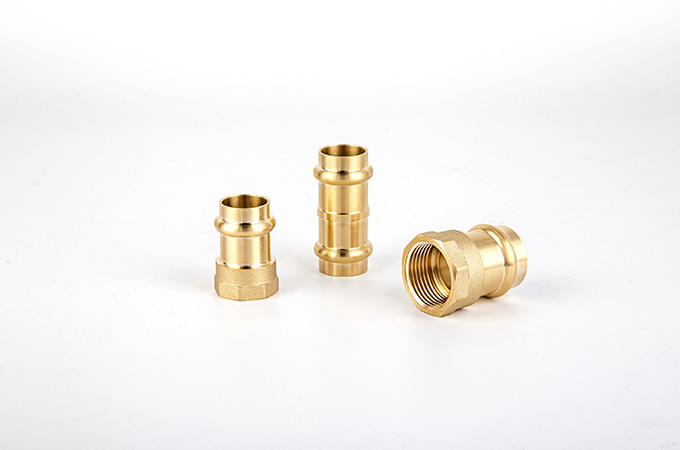
Characteristics:
1. Connection Method: The crimping connection uses a special sealing ring in the socket fittings to connect the pipes. The connection is made by using a dedicated crimping tool to press the pipe ends, which seals and secures the joint.
2. Brass Material Treatment: The product is made from high-quality brass, and a heating treatment process is used to effectively enhance the product’s toughness and strength.
3. Sealing Material: The O-ring is made from high-temperature resistant EPDM material, which meets NSF-61 hygiene standards, and is resistant to oxidation, ozone, and corrosion.
4. Enhanced Design: Compared to standard crimp fittings, this product has added anti-slip grooves, which effectively increase the tensile strength, providing customers with greater reliability.
5. Anti-mistake Function: Compared to standard crimp fittings, this product is equipped with an LBP anti-mistake function, addressing potential operational issues caused by oversight during installation.
Technical Parameters:
Working Pressure: 1.0MPa
Working Temperature: 0~93°C
Medium: Water, gas
Material: CW617N-DW, CW511L
Nominal Sizes: 15, 22, 28, 35, 42, 54
Installation Process
Pipe Cutting:
1. Copper pipes should be cut to the required construction dimensions by using a professional pipe cutting machine.
2. The pipe cutting end face should be perpendicular to the flow hole diameter to prevent the pipe from tilting after assembly.
3. The cut pipe end face needs to be deburred with a chamfering tool to prevent damage to the sealing ring.
Connecting Pipes:
1. When inserting the pipe into the fitting, ensure it is fully installed. You can mark the pipe with a line as a guide.
2. Use the dedicated crimping tool for installation. The crimping collar needs to align with the fitting’s arc. After crimping, ensure that the mark on the pipe has not noticeably shifted.
Post-Crimping Inspection:
1. Ensure that there is no leakage, separation, or deformation at any connection points under the specified water pressure.
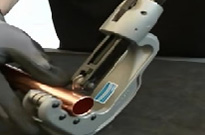
1. Cutting the pipe material
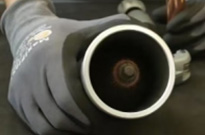
2. Cleaning the ends of the pipe

3. Marking the cutting line
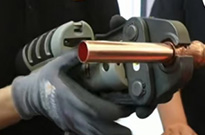
4. Pressing the pipe fittings together
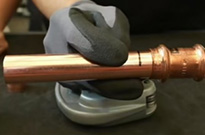
5. Unqualified Crimping Diagram

0086-576-87410818

hongdaer@hongdaer-valve.com

Subscribe to DATA product
No.3. Jinhai Road, Bin'gang Industrial Area,Ganjiang Town,Yuhuan, Zhejiang. China. 317610


Copyright © TAIZHOU DEOUNI FLUID CONTROL TECH CO LTD 2023 all rights reserved
浙ICP备20001112号-1 Design & Optimize : Feisu.cn


